WiFi, Bluetooth, and Zigbee are vying for primacy, and none of them is likely to disappear anytime soon (if ever). WiFi is the granddaddy, and arguably the most familiar. So, of course, WiFi is going onto all kinds of stuff. We see plenty of WiFi modules and chips, but CEVA suggests that you can save space if you integrate the WiFi directly into your SoC. (Assuming you’re doing an SoC…)
Sounds straightforward, but if you dig in just a little, an obvious question comes up: which WiFi? If you’re going the route of the PC, then you put on the most advanced version that has some level of support out there. Most likely, that’s still 802.11n, although (from a quick web scan) more expensive routers are now supporting 802.11ac.
But everything has a cost, and performance costs power, if nothing else. If you’re plugged into a wall, then wasted power is just wasted power. If you’re on a battery, on the other hand, then wasted power is a premature dead battery. So now there’s a choice to be made.
Another implication of the WiFi choice is the antenna arrangement. The newer versions support multiple-in/multiple-out (MIMO) configurations, which establish multiple “spatial channels.” You recognize these by the multiple antennas on a router (and the antenna configurations are typically indicated as AxB, where A is the number of antennas on the router and B is the number on the end station).
CEVA recently announced their RivieraWaves WiFi IP offering, and it’s divided three ways depending on how the WiFi will be used.
- For power-sensitive applications that don’t need the speed – like Internet of Things (IoT) edge nodes filing their sensor data reports – they offer 802.11n in a 1×1 configuration, referring to it as their SENSE version.
- For devices that need to shuttle more data around – surveillance, smartphones, wall-plugged smart-home IoT nodes – they bump up to 802.11ac in 1×1 or 2×2 configurations. They call this their SURF option.
- For heavy data use – routers and infrastructure and such, scaling to hundreds of users – they have a third version that configures 802.11ac in a 4×4 arrangement, named the STREAM option.
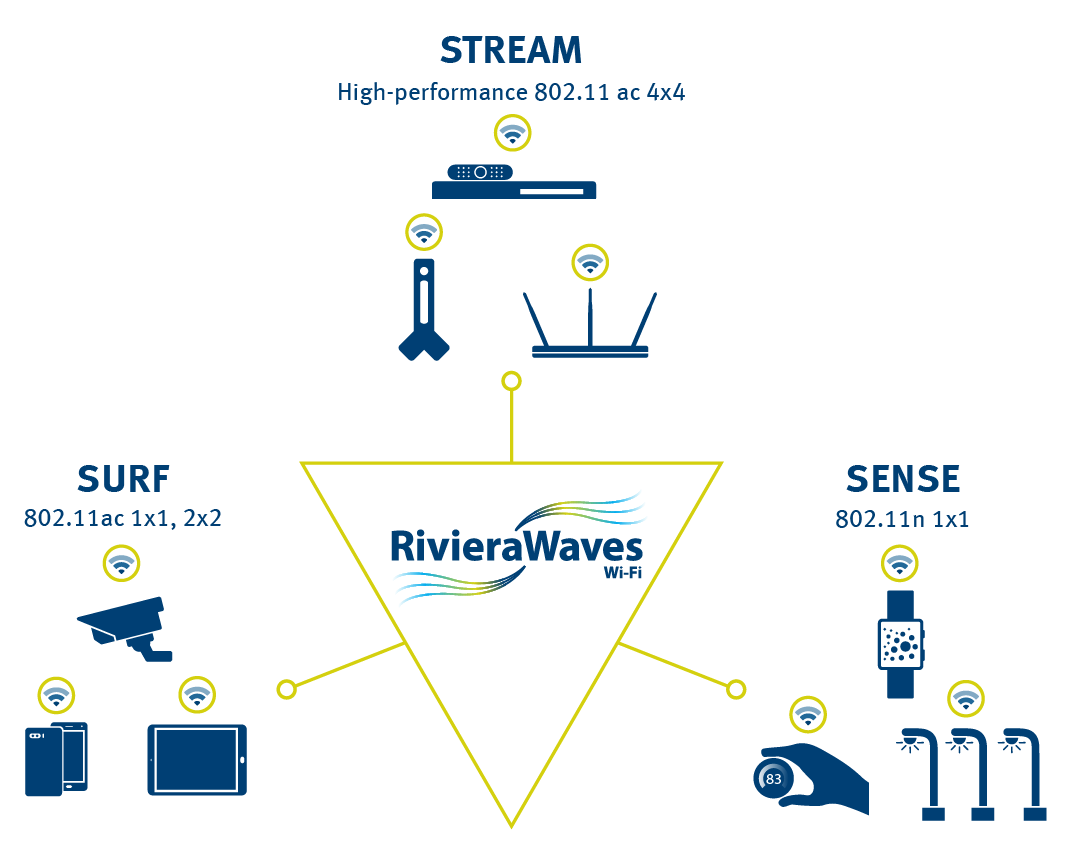
(Image courtesy CEVA)
The upper and lower MAC components are agnostic as to the processor or operating system is in charge. The modem functionality can be configured as optimized hardware or for software-defined radio for integration into a multi-protocol platform. And, of course, CEVA says that they’ve been designed to minimize power consumed – especially for the lower-end devices.
You can find more detail in their announcement.